
BeeLines - October '25
Updated: Feb 10
If you didn’t have a bountiful crop of honey this year don’t be too disappointed - join the club! Our harvested honey this year has been moderate. This is rather puzzling considering the summer weather that we experienced this year. We have had long spells of hot sunny weather that should have been ideal for the bees. It probably was ideal for the bees, but for some reason, or reasons, it has not led to a good surplus of honey. The bee colonies are in great shape, with heavy frames of sealed honey in brood boxes. Our own management probably reduces maximising for honey - we do make starter colonies for others, and with the early season spell of sunny weather we did take the opportunity to pre-emptively split a number of colonies. This was mainly to breed and increase from our best colonies; however, these actions were more or less what we do every season.
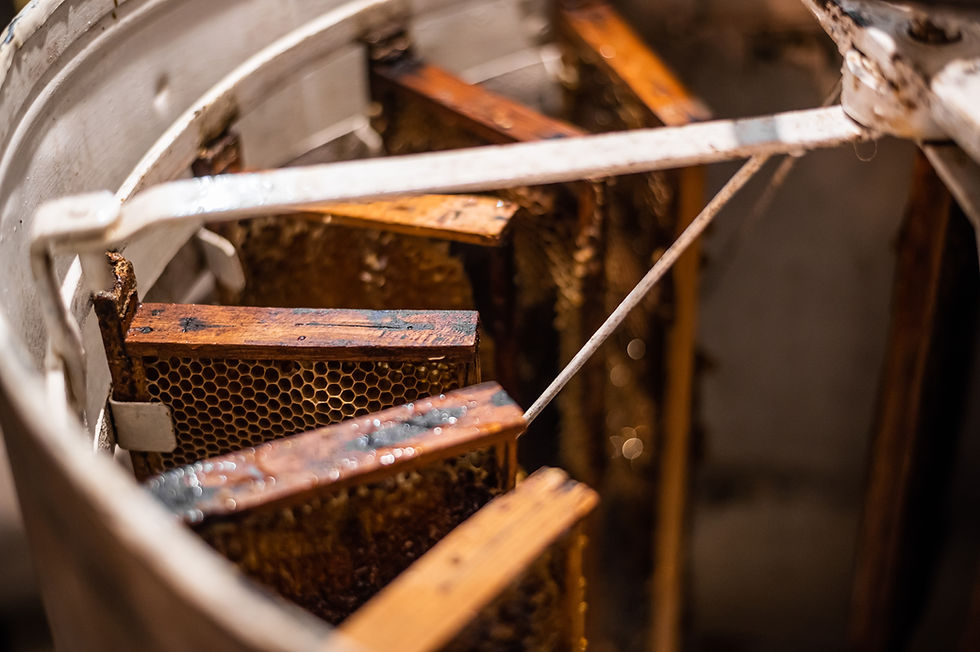
Why has this year been such a contrast to, say, the hot summer of 2022? In 2022 we struggled to keep up with extracting honey - it was outstanding and quite extraordinary. It may be that we have been unlucky this season, but we know from chatting with a number of members we are not alone. We have also heard that a number of BKAs who had placed large orders for jars have recently contacted a supplier to reduce those orders. As is often the case with beekeeping, bees had the ‘last say’ and a small number of hives - just two! - did really well. One hive was outstanding with four reasonably full supers, and another with three. Those however were the exception to all the other empty supers that ‘went up the hill, and came back down again!’
Hopefully some members may have had good harvests. If not, has anyone any suggestions to help explain this puzzle? Steffan Smith, a member who lives near to us and who I bee-chat quite often, suggested what we think is a really interesting idea. Steffan has given permission to share his suggestion.
“My season has been exactly like yours. Puzzling. The bees were slow to get going. A hangover from last season maybe. I kept expecting them to start packing the supers and getting into a full flow. It just never happened. Save for one colony that did ok, the others struggled to get any sort of surplus. They’re all super healthy and have brood boxes full of honey... just little or nothing in the supers. Very little swarm behaviour either. Only one colony needed swarm control.
I did wonder whether the fulsome nature of the fruit this year might have some link to the miserly nectar flow. As though the plants had focused their energy on fruiting rather than nectar/pollination?”
Fruit, apples, pears, and raspberries, for example, have done really well this year. Many fruits were well pollinated in the early spell of sunny summer. Do plants ‘give up’ the unnecessary production of nectar and pollen when their task for the season is completed? Thank you Steffan; for an interesting thought.
The International Federation of Beekeepers’ Associations - known as Apimondia - held its Congress recently in Copenhagen. Why do we mention this illustrious beekeeping event? It is because friend Steve Riley was presented with a silver medal for his book, The Honey Bee Solution to Varroa (copy in the LLEBKA library). Steve is doing an enormous amount of lecturing around the UK, and beyond, to enthuse and educate beekeepers to ‘start their own journey’ to developing varroa-resistant bees and become treatment-free beekeepers, Well deserved and well done Steve. Llŷn & Eifionydd BKA and our local area of varroa-resistant bees are referred to on page 4.
Earlier in the year we responded to a request for samples of propolis for a research study taking place at Lancaster University. To take part we fitted varroa screens under the crown boards of 6 hives. They were left in place for 2 months - July and August with us. The two stated aims of the research are: a) whether propolis has colony or regional variations and b) to what extent variation affects the behaviour of propolis. The propolis on all the 6 screens seemed similar to our eyes; lines of an off-white to light grey propolis. We hope to receive some feedback in due course, and trust it will be interesting information.
We are not sure how many members watch the webinars that the WBKA began during Covid lockdown and have continued since - credit to the WBKA for doing this. On the 11th September we watched and listened to the presentation by Jacques van Alpen, Prof Emeritus Leiden Uni. The title was, “Honey Bees - A Natural & Less Natural History”. It was a detailed and very persuasive scientific argument for the importance of locally adapted native or near native honey bees. Some of us find the genetics of honey bees difficult! And I don’t think I would get many marks being questioned on the genetic science of his presentation. But his case was clearly made by the more descriptive statements in his summary. Here are some quotes from Jacques, “Local adaptation is very important in honey bees - people should guard those local variations”. “Free mating is my most important message of the night”. And if you wish to know his view on the historic breeding of the hybrid bee at Buckfast Abbey, he stated it rather clearly, “Brother Adam is terrible! And we still suffer from him”!
BIBBA is enthusiastically promoting varroa-resistance and sends emails with interesting topics on bees and beekeeping every month. We think they are doing a great job to encourage interest in the native honey bees of the British Isles (UK & Ireland) and ‘the path to varroa-resistant bees’. https://bibba.com/varroa-resistance/
To end, we must mention a recent S4C programme that is really interesting to watch; it is very much bee related! ‘Cyfrinachau’r Llyfrgell’ with author (and enthusiastic beekeeper!) Caryl Lewis filmed at the National Library of Wales: https://www.bbc.co.uk/iplayer/episode/p0m4dnyq/cyfrinachaur-llyfrgell-cyfres-2-caryl-lewis
If you have comments, information, a bee story or tips you would like to share with members please let us know and we will include them in BeeLines.


Comments